Foundation AI
Shipping Foundation AI Systems at Enterprise Scale
 Amogh Babu K A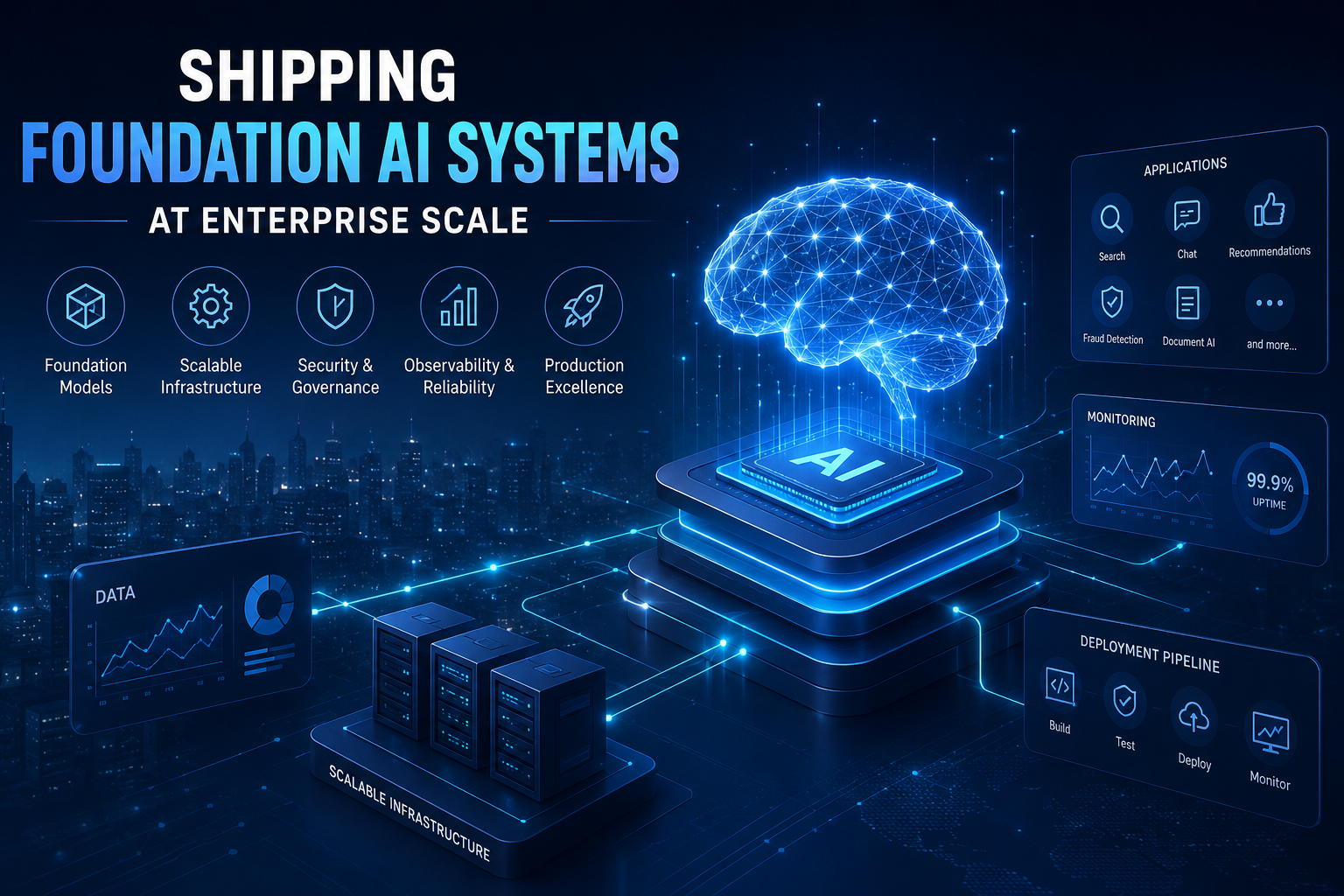
Foundation AI models have become transformative technologies in enterprise environments. However, moving from research or proof-of-concept to production-scale deployments introduces significant complexity. Organizations must navigate infrastructure challenges, governance requirements, cost optimization, and security concerns while ensuring reliability and performance. This blog post explores the key considerations and strategies for successfully shipping foundation AI systems at enterprise scale.
Understanding the Challenge
Foundation models – large language models, vision models, and multimodal systems—promise tremendous value. Yet enterprises face a critical gap between experimental success and production viability. The journey from a working prototype to a robust, scalable system requires addressing multiple dimensions:
- Infrastructure & Compute: Provisioning sufficient GPU/TPU resources while managing costs
- Latency & Throughput: Meeting SLA requirements for response times and concurrent users
- Governance & Compliance: Adhering to regulatory requirements and internal policies
- Security & Privacy: Protecting sensitive data and model IP
- Reliability & Monitoring: Ensuring uptime and detecting issues in real-time
- Integration: Connecting AI systems to existing enterprise workflows and data pipelines
Architecture Patterns for Enterprise Deployment
1. Modular API-First Design
Successful enterprise AI systems separate concerns through well-defined APIs:
- Model Serving Layer: Dedicated services for inference, separated from business logic
- Orchestration Layer: Manages workflows, routing, and fallback mechanisms
- API Gateway: Handles authentication, rate limiting, and request validation
- Monitoring & Observability: Comprehensive logging, metrics, and tracing
This architecture allows independent scaling of components and simplifies troubleshooting.
2. Multi-Model Strategy
Enterprise deployments rarely rely on a single model:
- Task-Specific Models: Smaller, fine-tuned models for specific use cases reduce latency and costs
- Fallback Mechanisms: Route to alternative models when primary service degrades
- A/B Testing: Compare model versions to optimize performance
- Ensemble Approaches: Combine outputs from multiple models for improved quality
3. Hybrid Deployment Models
Different use cases require different deployment strategies:
- On-Premises: For highly regulated industries or sensitive data
- Private Cloud: Dedicated infrastructure with enterprise security controls
- Managed Services: Outsourced inference for commodity use cases
- Hybrid: Mix of approaches based on workload requirements
Infrastructure Considerations
Compute Resource Management
Efficiently managing GPU/TPU resources is critical for cost control:
- Batch Processing: Group requests for non-real-time use cases
- Dynamic Scaling: Auto-scale based on queue depth and latency metrics
- Resource Pooling: Share compute across multiple models and applications
- Cost Monitoring: Track spend per application and model
Latency Optimization
Meeting latency SLAs requires attention to multiple factors:
- Model Quantization: Reduce model size while maintaining accuracy
- Caching Strategies: Cache common queries and model outputs
- Request Batching: Balance latency-throughput tradeoff
- Geographic Distribution: Deploy models closer to users when possible
Data Pipeline Integration
Foundation models require seamless integration with enterprise data:
- Data Preprocessing: Clean, format, and validate input data
- Feature Engineering: Create relevant inputs for improved model performance
- Output Processing: Format model outputs for downstream systems
- Data Governance: Track lineage, ensure quality, and maintain compliance
Governance & Compliance
Model Governance Framework
Enterprise AI requires governance structures:
- Model Registry: Central inventory of production models with versioning
- Approval Workflows: Review processes before production deployment
- Documentation: Clear specifications for each model’s purpose and limitations
- Audit Trails: Complete history of model changes and deployments
Regulatory Compliance
Different industries face different requirements:
- Financial Services: Model risk management, explainability requirements
- Healthcare: FDA regulations, HIPAA compliance, clinical validation
- AI Regulation: GDPR AI Act compliance, transparency requirements
- Data Privacy: Data residency, retention, and deletion policies
Responsible AI Practices
Enterprise deployments must embed responsibility:
- Bias Testing: Regular evaluation of model fairness across demographics
- Explainability: Provide reasoning or confidence scores when possible
- Human Oversight: Maintain human-in-the-loop for critical decisions
- Incident Response: Procedures for responding to model failures or misuse
Security Architecture
Data Security
Protecting sensitive information is paramount:
- Encryption in Transit: TLS/HTTPS for all API communications
- Encryption at Rest: Protect stored data and model artifacts
- Access Control: Implement least-privilege access principles
- Data Isolation: Separate sensitive workloads from shared infrastructure
Model Security
Safeguarding AI models themselves:
- Model Signing: Verify model integrity before deployment
- Access Restrictions: Limit model download and inspection
- Adversarial Testing: Evaluate robustness against adversarial inputs
- Prompt Injection Prevention: Validate and sanitize all user inputs
Operational Security
Secure deployment and management practices:
- Infrastructure as Code: Version-controlled, reproducible deployments
- Secrets Management: Secure handling of API keys and credentials
- Network Segmentation: Isolate AI services from general networks
- Incident Logging: Comprehensive logging for security investigation
Monitoring, Observability & Reliability
Key Metrics to Monitor
Effective monitoring requires tracking multiple dimensions:
- Availability: Uptime percentage and incident frequency
- Latency: P50, P95, P99 response times
- Throughput: Requests per second and queue depth
- Model Quality: Accuracy, drift detection, user satisfaction
- Cost: Spend per request, compute utilization rates
Detecting Model Drift
Models degrade over time as data distributions shift:
- Input Monitoring: Track changes in input data characteristics
- Output Monitoring: Detect unusual output patterns or distributions
- User Feedback: Collect feedback on model quality
- Periodic Retraining: Scheduled model updates with fresh data
Incident Response
Prepare for failures with structured response:
- Alert Thresholds: Automatic escalation when metrics exceed thresholds
- Playbooks: Documented procedures for common failure modes
- Fallback Systems: Switch to alternative models or services
- Post-Mortems: Learn from incidents to improve reliability
Cost Optimization Strategies
Right-Sizing Infrastructure
Optimize compute allocation:
- Capacity Planning: Forecast demand and provision accordingly
- Reserved Instances: Use long-term commitments for baseline capacity
- Spot Instances: Leverage cheaper spot/preemptible instances for batch work
- Model Selection: Choose smaller models when accuracy permits
Efficient Inference
Reduce per-request costs:
- Caching: Store frequently requested outputs
- Distillation: Train smaller student models from larger teachers
- Pruning: Remove unnecessary parameters from models
- Quantization: Reduce precision while maintaining accuracy
Workload Optimization
Restructure work for efficiency:
- Batch Processing: Process multiple requests together
- Asynchronous Processing: Decouple real-time requirements where possible
- Request Prioritization: Process high-value requests first
- Load Shedding: Gracefully reject low-priority requests under load
Integration Patterns
Embedding in Applications
Common approaches for application integration:
- API Services: RESTful or gRPC endpoints for synchronous inference
- Message Queues: Asynchronous processing via Kafka, RabbitMQ
- Lambda Functions: Serverless execution for event-driven workloads
- Database Plugins: Direct integration with data systems
Enterprise Workflow Integration
Connecting to existing business processes:
- Workflow Engines: Embed AI steps in business process automation
- Data Warehouses: Integrate predictions into analytics platforms
- CRM/ERP Systems: Connect AI insights to business applications
- BI Tools: Visualize AI outputs in existing dashboards
Common Challenges & Solutions
Challenge: Managing Costs
Problem: GPU compute is expensive; costs can spiral without discipline.
Solutions:
- Implement chargeback systems to allocate costs to business units
- Use auto-scaling to match resources to actual demand
- Explore alternative inference platforms (CPUs, edge devices)
- Monitor cost per transaction and optimize continuously
Challenge: Ensuring Model Quality
Problem: Production data differs from training data; models degrade over time.
Solutions:
- Implement continuous monitoring for model drift
- Establish retraining pipelines triggered by quality degradation
- Maintain diverse test datasets for validation
- Implement human-in-the-loop feedback loops
Challenge: Regulatory & Compliance Risk
Problem: AI systems operate in complex regulatory environments.
Solutions:
- Engage compliance and legal teams early in development
- Implement audit trails and documentation systems
- Perform regular bias and fairness assessments
- Design for explainability and interpretability
Challenge: Organizational Change
Problem: Deploying AI systems requires cross-functional collaboration and new skills.
Solutions:
- Establish clear ownership and accountability
- Invest in team training and development
- Create centers of excellence for AI best practices
- Foster collaboration between data science and engineering teams
Best Practices Summary
- Start with Clear Use Cases: Identify high-impact, well-scoped problems
- Design for Scalability: Plan for 10x growth from day one
- Automate Everything: CI/CD, testing, deployment, monitoring
- Monitor Comprehensively: Instrument all systems for visibility
- Plan for Failure: Design redundancy and fallback mechanisms
- Iterate Continuously: Treat production systems as learning opportunities
- Invest in Data Quality: Clean, representative data enables better models
- Security First: Build security into architecture, not as an afterthought
- Enable Observability: Make it easy to understand what’s happening
- Foster Collaboration: Bridge the gap between researchers and engineers
Conclusion
Shipping foundation AI systems at enterprise scale is complex but achievable with proper planning, architecture, and execution. Success requires balancing innovation with reliability, managing costs while ensuring quality, and embedding governance and security into every layer of the system.
Organisations that master these challenges unlock tremendous business value from improved customer experiences to operational efficiency to entirely new business models. The key is approaching enterprise AI deployment systematically, learning from successes and failures, and continuously improving your processes and capabilities.
The foundation models are powerful tools. The hard work and the competitive advantage lies in deploying them effectively at scale.